Monday, 5 October 2015

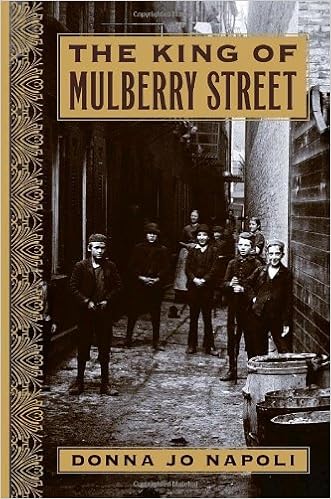
Review of Donna Jo Napoli's "King of Mulberry Street"

subtitle: Homeless Children as a Literary Genre
 
In my opinion, there should be a new genre added to the list, called "street kids" or "homeless children". It would be a sub-genre to others, such as memoirs and true life experience, for example, Justin Reed Early's Street Child: A Memoir which I've downloaded and plan to read next, Fr. Joe Maier's Welcome to the Bangkok Slaughterhouse, whom I had the privilege of working with in Bangkok; science fiction/cyberpunk, such as my own Pepe; or current or historical fiction, such as Charles Dickens' Oliver Twist, Fallen Angels: Stories of Los Gamines, and, definitely not least, Donna Jo Napoli's The King of Mulberry Street, which I've just finished reading. While accepting it as a literary genre, however, let's be careful not to romanticise it too much, remembering that these things really do happen to real children in many parts of the world.

Whether historical, futuristic or present, certain factors always remain the same. Human nature hasn't, and will probably never change. Cruel opportunists exited in Dicken's time, they exit now, and will exist in the future (judging by the way things are going). Examples include the "padrones" in Dom Napoli's late 19th century New York, where they helped children to emigrate, but kept them as slaves, working them on the streets. And what about futuristic technology? The street kids are too busy trying to keep themselves fed to worry about that, let alone afford any of it. If anything, it makes their lives worse. Street kids of all ages don't even wear shoes -- with the exception of Dom Napoli, whose mother thoughtfully bought him a pair shortly before sneaking him on board a freighter to America.

When I refer to Dom Napoli, I mean the main character of the narrative written by author Donna Jo Napoli. Dom, the character, is a nine-year-old Italian Jewish boy from Naples, and is based on what the author, Donna, imagines her own ancestor to be (who emigrated at the age of five). Like Donna's ancestor, Dom finds himself totally alone in America. He chooses the surname of Napoli because that's where he's from. He doesn't know a word of English, but he's heard that Mulberry Street is where there are people who speak Italian with the Napoli dialect. He follows a man whom he heard asking directions to Mulberry Street, until he arrives there. Maybe, he hopes, he'll find an uncle he knew to have emigrated there previously. He doesn't. Instead, he sleeps in an old barrel not far from a dead dog -- at least no one bothers him all night. But what next...?

Dom seems to be quite an intelligent and resourceful boy for his age, and he actually makes it, and becomes successful at selling sandwiches and helping out his friends. One might be tempted to think that the story isn't very realistic on this point, but it has happened before. At least the author's great-grandfather survived on his own as a five-year-old immigrant and, although the details of that are sketchy, did eventually start a similar business. One rule of writing fiction is, "Truth is stranger than fiction" – meaning that regardless of miracles that may happen in real life, fiction has to remain believable. Donna Jo Napoli, at least, kept this rule by making her main character a nine-year-old instead of a five-year-old.

In a street kid's everyday life, there are plenty of obstacles to overcome -- enough to fill up any literary genre. Life on the streets can be as dangerous as jungle warfare, or laser battles in an alien landscape. There's plenty of possible action to draw on. If anything, the writer's challenge is deciding whether he/she has made it too easy on the main character, or made life too dismal for the reader to enjoy -- I speak from experience. In reality, some people do survive a childhood like that, but in fiction there must be a balance between reality, believability, and maintaining it as a pleasant read. Remember, “truth is stranger than fiction (and must be kept so)”. On the other hand, I don't think any realistic story about homelessness can be told without relating at least one tragedy, as also happens in The King of Mulberry Street. Donna Jo Napoli has handled all these factors like a pro.

As historical fiction goes, Donna Jo also pulls it off well. Not only does she portray street life in New York, but also nineteenth century Naples – including some things one doesn't find in fiction. Back then, it was actually normal to see kids skinny-dipping in the river or seaside both in Europe and in America, as we also see from the paintings of that era, by the likes of Joaquin Sorolla Bastida and George Wesley Bellows, and the photography of Francis Sutcliffe. But one of the last things Dom's mother told him, besides things like “Watch and learn”, “Get an education” and “Simply survive”, was don't undress in front of other people. That was to hide his circumcision, which would lead to another hazard of that age – anti-Semitism. That, and keeping kosher is another of Dom's challenges in the New World. Not only is he resourceful, but his vulnerability on one hand, and his generous heart on the other, make him an endearing character.

All of it is narrated from inside Dom's head. It's in first-person past-tense, but it could have just as well have been present tense. Donna Jo puts us right there in Dom's shoes. Yes, I get it – he did have shoes.

Tuesday, 15 September 2015

The IndiePENdents.org Seal of Good Writing

My book, Pepe (shown in the previous post) has been awarded the Seal of Good Writing by IndiePENdents.org. Read the announcement on their Facebook page here, and their mention in their newsletter here.

A downside to the self publishing, or "Indie" world of books is that one doesn't know where to look to find good worthwhile reading. There are good books there, but they may be difficult to pick out from those written by raving crackpots, or those readable only by the authors mother. IndiePENdents.org acts as a unified voice of independent authors, and a means of verifying the good writers from the bad. Membership is free. Then, a panel of authors and editors, themselves members, goes through the submissions of members, and the well written, well edited and well formatted books get their Seal of Good Writing.

Any writers among you, do join! Anyway, it feels good to be a part, and have their seal of good writing.

Sunday, 30 August 2015

New cover and blurb for Pepe

I've given Pepe a new cover, as well as a new blurb, which follows:

 In a world of flying magnetic trains and floating cafés, he lives in an abandoned construction site with his sister, cleaning windscreens at a busy intersection while his sister begs. He doesn't know who he really is. That fact could cost him his life – or it could be the key to the future of Cardovia. The evil general and president-for-life, a paraplegic whose mobility depends on a brain-computer interface controlling an army of robots, wants him eliminated.

The general's secrets are well-kept, except to a mysterious mystic old Japanese man who has hope, and a 13-year-old hacker who accidentally witness one of his heinous crimes. For Pepe, it's a “coming of age” as he discovers his past, and the dimmest images of his dreams begin to materialise.

Before the end, we see things falling apart as hope plummets into oblivion, while all are perusing what might be a lost cause, when suddenly a forgotten fact pulls it all into a satisfying conclusion.

"Books this good usually don't show up on my radar... Excellent nerd sci fi totally deserving your money." -- Ezekiel Carsella at Books N Tech

"Pepe was an action packed ride that I enjoyed from start to finish. Mr. Charters has a way of creating a near future in exquisite detail, and I felt like that really made the story." -- Paige Boggs at Effectively Paige 

For the Kindle edition click here after which please click on the cover icon.
For any other eBook format, click here.

Monday, 3 August 2015

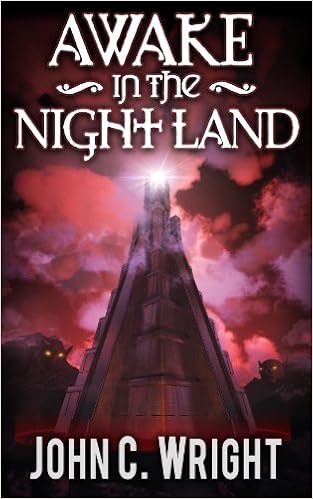
The Night Land -- John C. Wright, William Hodgson, et al

This is a collection of four novellas based on the world of William Hodgson's The Night Lands. The first novella is available as a free download, which I read before buying the full version. After reading the second one in the series, I went to Gutenberg.com and downloaded William H. Hodgson's book, The Night Lands. I'd say those actions should speak for themselves as to how much I liked John Wright's work.

William Hodgson's Night Lands could be up there with Middle Earth and the Star Wars universe, except that Hodgson's narration of it is so difficult to slough through. John Wright has done a commendable job of moving it into public literary consciousness with his excellent writing -- much easier to read while still using grand literary style.

The premise: it's millions of years in the future, the sun has died, and the earth is in darkness. The thick cloud surrounding the earth also blocks out the stars. A variety of horrific monsters have taken over the landscape, some of which can, not only kill the body, but also consume the soul as well. Humanity is surviving with the help of subterranean heat. Human technology of that time has enabled them to build a 7 mile tall pyramid shaped tower, called The Last Redoubt, capable of holding millions of people -- all that's left of humanity. Each floor is a whole city. For more details of the fascinating world, read the Wikipedia entry.

I never did finish William Hodgson's book. I got more than half way through, which was enough to give me the basic idea of the story. William Hodgson was a Victorian age writer, but he intentionally wrote it in 16th century style, from the narrative point of view of a gentleman living at the time. He falls in love with a young lady named Merdath. They marry, but she dies. During his mourning, he has a dream of the far future, where a reincarnation of himself, a young man, lives in the Last Reoubt. Through highly advanced instruments and his own telepathic powers (which humanity has developed by then), he hears a voice he recognises, that of the reincarnation of Merdath. She's calling from a lesser redoubt at the opposite end of the extremely deep valley in which both redoubts were built. They were built there because the air at the old earth's surface is too thin to breath. Also, in the valley, there are scattered pot holes of lava that are good for warming oneself. The Last Redoubt, itself, is warmed and energised by a large vein of subterranean energy.

After Hodgson's hero begins hearing the voice of his ancient lover, it becomes apparent that something horrible has happened to the Lesser Redoubt. The first half of the book is the journey through a landscape every bit as full and detailed as Tolkein's Middle Earth -- the difference being that almost everything is hostile and dangerous. He finds her, and the second half covers their journey home, and, I suppose, a bit of their life back at the Greater Redoubt. As I said, I didn't make it to the end, as a lot of that was more like a 16th century romance, with very wordy and detailed descriptions of their love, which didn't appeal to me.

When John C. Wright was young, Hodgson's book existed in two out-of-print volumes. Young John had found the first volume, read it up to the part where the hero was on the verge of finding Merdath, and spent the rest of his young adulthood pining for the second volume. Gutenburg.com wasn't around then. His compendium of novellas stays faithful to the world of William Hodgson, including the reincarnation aspect. Reincarnation is a necessary part of the Night Lands universe. John C. Wright is a Roman Catholic who doesn't believe in reincarnation, but neither does he, nor I, believe in witches riding on broomsticks or small men with hairy feet who live in holes, but we still enjoy an occasional story or two that feature such things.

The first three stories in Wright's collection are set in the Night Lands as Hodgson knew them. His story of the search and rescue of Merdath, is a part of the history. The fourth is set at the end of the universe as we know it, one that has passed the "Night Lands" phase of human history, but takes a twist that only John Wright can give it, with his brilliant adaptation of the physics of time and space.

My recommendation: discover the Night Lands through John C. Wright's book, and later, if your appetite has been sufficiently whetted, download William Hodgson's book.

Sunday, 2 August 2015

Limericks

The previous post was an extract from my book, Pappa Gander: the Less Better Half of Mother Goose, pictured to the right. That's basically a collection of my less serious attempts at rhyming, parody, and the retelling of well known fairy tales. There are other nursery rhyme parodies as well -- though mostly short ones -- but below, I'll paste a collection of limericks. Those of you who follow me on Facebook, may recognise some of them.


Barbarians and Samarians

Barb, a barbarian from Barbaria
And her man, lived in a wire barbed area
Sign said, 'Trespassers beware
Though I shoot first, I be fair.
If mistaken, I'll have my wife, Barb, bury ya.'

Samson and son, Sam, in Samaria
Lived in separate houses in the same area
Sign said, 'Trespassers beware.
But if you're feminine and fair,
I'll not shoot, but I'll have my son, Sam, marry ya.'

Reinventing the Wheel

when willie reinvented the wheel
we all laughed and called him a schlmiel
then it so happened
that he took out a patten
now it's his licence fees that make us reel

the first draft of a limerick:
a seemingly educated limericist named curdy
writes limericks too over exceedingly wordy
in spite of how much he tries
to sound educated and wise
one moreover wonders as to how one fringes so on the edges of absurdity

the final draft:
poet named curdy
was too wordy
being wise,
downsized
now sounds nerdy


Saturday, 25 July 2015

The Misadventures of Jack and Jill


grandmother hubbard, to keep food in her cupbord
and pay the rent
on her shoe
sent little jill moffet and her cousin jack
to find some work to do

young jack horner found a secure corner
with jill in the royal kitchen
it was really quite modern
-- it had 'running water'
their job was, 'run', do the fetch'n

the the royal well was up a hill
at a distance of about one mile
a precarious climb, took lots of time

but the water in the moat was vile


said jack to jill, 'to climb that hill
with the well, we must move faster'

but jill nudged jack, he nudged her back,
they broke into a peal of laughter

so into the slop the bucket did drop
and came up black as a blotter

now, with time to kill, and their bucket of swill,
to pass off as kitchen water
they sat on the wall, but had a great fall
and the pail came splashing after
all the kings horses and all the kings men
went up the hill with the bucket again
they too, fell down, broke the king's crown
and the king came screaming after


jill and jack were given the sack

and meanwhile
back at their shoe...
old mother hubbard went to the cupboard
to open a tin of stew

but her little dog laughed, 'old woman, you're daft!
the cupboard
you'll find so bare!
why, even the spoon, with an amorous dish has eloped to las vegas, so there!
'the cat was ask'n
for the fiddle for busk'n
and since, he hasn't been seen
he said his first act is
in london -- must practice
he hopes to play for the queen'

said hubbard, 'well, now, we've still got our cow'

'you forget so soon! the bean
and the commodities trader, who wiped jack clean
he turned around and made a killing
he sold it to NASA for many a shilling
who sent it into orbit in search of the moon'
laughed the dog, 'funnier than loony toons!'

finally jack and jill returned to their shoe
with their severance pay, and feeling quite blue

'oh granny dear, we sadly fear,
our royal job we've lost!'

'you naughty kids! you've lost your lids!
do you know how much food costs?
I'll whip you both soundly and send you to bed
and feed you broth...'

'not me!' jack said


and out he did hurry to the neighbour, mary
and jill came running after
now teacher mary, could be quite contrary
-- intolerant of laughter


contrary mary had a lamb,
his fleece was white as snow
he accompanied her to her class, and he helped her garden grow

'teacher mary, quite contrary,
what grows upon your land?'

'what grows? I wouldn't know
you'll have to ask the lamb'

'...so, lamb?'

'(call me sam)
er -- that bean you bought with your cow'


'the magic bean? it hasn't been seen
since the day we had that row!'

'it's really quite grand, it
grew where it landed
look out back, you'll see it right now!'

jack looked up, couldn't see the top
and turned to say to jill,
'shall we climb? i think it's time
it would be quite a thrill


then, who (diddle diddle) should arrive with his fiddle?
but the cat, who was looking quite ill

'pussy cat, pussy cat,
where have you been?'

'i've been to london
to play for the queen.'

'pussy cat, pussy cat,
how much did you earn there?'

'hardly enough to cover the bus fair'


'but why (diddle diddle) did they pay you so little?
their budget is over the moon!'

'...and her corgis laughed
and gave me a fright...'

'...and why are you home so soon?'

'a diller a euro, a ten 'o clock bureau-
crat said i must be out by noon

plus, old king cole, being a merry old soul,
already employs fiddlers, three
they play for their supper of white bread and butter
but the rest they do for free

but you, master jack, why are you back
so soon from the royal court?'

'alas,' said jill, 'they said, "you will
bake a pie", but jack miss-heard
instead of "berries" numbering four and twenty
jack thought that they said "bird"
(what he heard as "bird",
was a reference to his brain
but hear the rest, it's quite insane)
so off he went to catch the winged critters
to bake inside the pie


bought the lard for a song and sixpence
and a pocket full of rye


but when the pie was open
jack's birds began to sing
songs of euros and sixpence
and all that sort of thing

so both of us were unceremoniously ejected
from the royal kitchen
and demoted to the job of royal water fetch'n'

now the little cat laughed to hear such a tail
that his spirits went over the moon
he no longer looked ill, so jack and jill
said, 'c'mon, let's have some fun'
teacher mary,
being quite contrary
warned, jack, 'be nimble, jack be quick
when jumping over my bean pole stick'

so doing, jack and jill went up the beans talk
and the cat came climbing after
and so did the lamb, whose name was sam
while mary was none the dafter


they reached the top, and had to stop
the beanstalk went no higher
said jack to jill, the cat and sam
'what now? you know, i am no flyer'

said sam, 'let's eat. i've found a treat --
these beans, along the way
in kurdistan, i understand,
they eat the beans this way.'

so, little jill moffet, used a leaf for a tuffet,
sat, eating the kurdish way
while little jack horner found a leafy corner
and frightened the spiders away


but the beans they ate made them flatulate
so strongly, it propelled them upward
so did they begin, from the gas within,
to fly, though they felt awkward
up-up they went, by gas they were sent
with beans for rocket fuel
up to a home, where the giants roam
and other things most cruel
they came to a road, and down it they strode
across the cloudy floor
at mile post two jack buckled his shoe

at mile post four they came to a door

its height was six (in meters). 'oh styx!
my watch says eight, let's lay this this straight'
said the cat. 'it's much too late to be home by ten.'
so they knocked at the door, and a big fat hen
invited them into the kitchen, and then
jack asked, 'pray tell, who your master?'

'a tinker, a tailor, a soldier, a sailor,
a rich man, a poor man and a beggar man,'
was her clucking answer.

'a greedy lot are they; can you take me away?
I've had it up to here!'
she took a look out the window and shook,
and with a cackle, said, 'oh dear!'

to the window ran jack, jill, sam and the cat
outside were seven bearded men
tall they were, yes, but almost as fat
they saw fear in the eyes of the hen

'hi ho, hi ho, and a fi fie fo fum
to home from our various occupations we've come
we've dillied and dallied throughout the day
done crosswords and twittled our thumbs'

at the sight of the men, jack grabbed the hen
and into the great oven they hid
on the count of four, they shut the door
it's just as well that they did


announced the tinker,
'dear tailor, brave soldier, swaggering sailor,
gentle rich man,
humble poor man,
fine beggar-man,
amongst us there dwells a thief.'


spake the tailor, 'you stinker!
though crafty, you're no thinker.
your occupation as a tinker
makes you suspect of giving us grief!


Said the poor man, 'you pig!
your a racist and a prig!
I say, it's the bigwig:
what's made him rich beyond belief?'


cried the rich man, 'I'm all a flutter!
who pays the rent?
buys bread and butter?
who, but for me,
you'd be still in the gutter?'

'not you,' did the beggar-man utter.
'it's our gold laying hen who's brought us relief.

'our gold laying hen, she's fled for the hill,
go now, you lot, you may catch her still!'
he looked towards the oven and winked.
the other six strode to their horses and rode;
said the beggar-man, 'in here, I think.'

said the beggar-man to jack and sam,
don't worry yourselves, just a beggar I am
a beggar I was, a beggar I'll be
life in the gutter is no hardship for me
I'd just as soon they learned their lesson
for me, outdoor life will be a bless'n

said jack to the man, 'how flustered I am!
this story's all wrong!'
'and I,' said the lamb
'feel much the same.
I recognise that but for your size
you're the 7 dwarves of snow white fame!'


spake the beggar-man,
'you're not to blame.
you guessed 7 dwarves,
we're one and the same
but if you think that we're a sight
you should see the size of snow white!


'now, off you go, and take the hen
and return to where your journey began
and take this harp, it sings by itself.'
he gave them the instrument
from off the shelf


off they went the way they came
they reached the edge, but it looked the same
no beanstalk, no beans, no rocket fuel
said the lamb, 'what a world most cruel!'
little jill moffet, sat on her tuffet
thinking of words to say

along came a spider in a hang glider
and said, 'you folks going my way?'
they all hitched on and glided down
but the contraption began to totter
jack fell down and bunged his crown
and the hen came flapping after

jack came to, and wondered who
had brought him to his chamber
he wasn't dead, but in his bed
wrapped in vinegar and brown paper

in walked hubbard, 'there's food in the cupboard!
that hen that followed you home
was so big and fat that it filled the pot
it'll do till it's nine days old!'

... sad for the hen, and their prospects for gold
but not all was lost, for, so I am told
the cat still goes busk'n and for many a shilling
plays duets with the harp -- they make a killing!


Friday, 24 July 2015

Review of Florian Armas' Io Deceneus

We know the main character only as Deceneus. Even then, he's not quite sure of that name, nor in what sense he's “Deceneus”. There was one of that name much earlier in the history of that planet, and a belief in another yet to come. It all comes together in the course of the story.

Not that we really need a name for him; the narrative point of view is from inside his head, but it's not just a simple first person POV – it's a stream of consciousness where each two-person dialogue becomes a three-way conversation, his own thoughts interjected as the third party. It makes for a unique reading experience, though it may take some getting used to. But I like literary experiments like that.

We begin the ride on Earth, where his name isn't Deceneus, nor is there anything about him that would suggest he's to be a hero of an other-worldly scenario – except, perhaps, the dream described in the prologue. We find him wallowing in alcohol and self-pity, having recently lost his job.

Later we learn that dreams are the way that “gates” and similar beings test those who might be suitable recruits for time travel. Deceneus nick-names his “gate”, “Houston”, after NASA's Houston – as in “Houston, we have a problem”. And, there's no shortage of problems, which “Houston” has to mother him through in order to make him ready for his first contract.

Apart from the “gates”, there are many other intelligent creatures inhabiting the universe. Most of them far surpass humans in brain capacity (a refreshing change from most SF I've read), so much so that humans and other similar races are seen as experiments, or even game pieces in the “game that's not a game” (you'll come across that phrase). The “game” involves making adjustments in timelines to affect the future welfare and/or extinction of whole races. Some beings treat it as a big game, while others are more concerned about the welfare of the “small brain” races. Among the more advanced beings are the “Factions”, the ones playing the leading roles in the “game that's not a game”.

The most superior being of all is the Universe itself, who makes His presence known in our galaxy though what's know as the “Black Eye”, the giant black hole at the centre of our galaxy.

Sometime during the formation of humanity, a mistake or accident occurred that resulted in humanity becoming an unusually ambitious and warlike race. It also made them suitable candidates to be sent to other times and places to interact with local populations to manupilate their history, as in our story.

Thus, our main character accepts a contract with a “Faction” for whom Houston is acting as an agent. After receiving intensive Samurai training and gaining other skills, he is downloaded into a human-like body on a planet sometime in our distant past, that's inhabited by at least four different human-like races, as a member of one of those races. The local population has reached a level of sophistication approximating our 19th century. He has also had the local language downloaded into his brain, as well as an inner “encyclopedia” of local knowledge. Then, he's placed at just the right place at the right time to enter society as a hero. Of course, to complicate things, there's another Faction already at work there with a conflicting agenda.

That last paragraph is a vast oversimplification: he actually makes several arrivals on the planet, involving a lot of trial and error. One of those arrivals is to the even more distant past, when the local population is in their stone age. Though that story is brushed over very quickly, he spends quite a number of years of their time teaching them basic civilisation skills and saving them from extinction. Actually, they did become extinct because of a wrong choice on his part, but Houston enables an alternative time-line, and they're saved. All that is a part of the preliminary learning experience.

The book is full of creative applications of time-and-space theories and ideas about alternate time-lines. One more device I should mention is the “SAT-mine”, a giant spherical force field that has the potential of totally erasing ones existence, adjusting the time-line so as to totally exclude that person, and any effect they might have had on anything; so they were never born. They are meant to be a deterrent against destroying the fabric of space and time, but too often they're used against those altering the time-line in ways disagreeable to certain very powerful forces; which Deceneus is in constant danger of doing. If he were erased, an entire race of beings on that planet would also cease to exist because, remember, it was he who saved them from extinction back during the stone age. Deceneus still wants to save the local “small brain” races from extinction, which puts him in conflict with the Factions.

So, that's the premise and the setting of the story. Because of Florian's narrative style, it took some effort to read through parts of it without taking a rest now and then, and a few of the stretches, ones involving local politics, were so long that I began to wonder if they were going anywhere; but they were necessary to the story, which was so superb and worth the effort that I'm giving it five stars.

Wednesday, 22 July 2015

The Land of Bad Elves: a review of M.B. Mooney's The Living Stone

Unlike Middle Earth, the elves are the evil empire. The human lands of Erelon have been ruled for many years now by the elves of Kyrus. They've tried to wipe out traditional monotheism, and have imposed their own ways on human society. However, there are pockets of those who have held on to their belief in El. Among them are those led by one known as the Prophet.

Caleb De'Ador had been missing since he was 15, captured by the elf authorities and taken to Kryus, the centre of the elven empire. The high ranking elf that was in charge of him happened to be sympathetic towards the human nation, realising the injustice of his own kind. He had Caleb trained as a Bladeguard, something like a Samurai. Caleb returns to Erelon, intending to seek the Living Stone, which would confirm him into the ancient order of the Sohan-el. They are the true Samurai-like defenders of the faith that are now only a legend, and of which the order of the Bladeguard are a copy. To become a Sohan-el, a trained swordsman who has taken the oath must seek the living stone, an iron rock with a tree growing out of it, and lay his hand on it. If he is found worthy, the rock will released an unforged sword, the symbol of his office. The Sohan-el haven't been around for hundreds of years. As a Sohan-el, he can begin to lead humanity to stand up and fight for their freedom, and restore their glory as nations under El.

On his return to Erelon, Caleb finds that the Prophet, his uncle, has been imprisoned by the elves in a strong fortress-like prison. A local gangster introduces him to Aden, a child of the streets, who is the only one known to have escaped this prison. He offers to help under one condition, that he be allowed to accompany Caleb and the Prophet on their journeys. Caleb reluctantly agrees, and they bust the Prophet out.

Meanwhile, in the mountains to the West, a door to the underworld has opened, which happens once in 527 years. A legion of demics (a sort of small orc or troll) pour forth, led by a giant horned Demilord named Thoros. They once roamed freely on the face of the earth until they were imprisoned in the underworld by the Sohan-el. Every 527 years, when the door opens, a limited number of them escape with the goal of finding the key to the underworld, so that they can reopen the door and let the rest of them out. They begin their journey to the northern city of Ketan, devouring every living thing in their path. The demics eat human flesh, but the demilord eats their souls -- reminiscent of William Hodgeson's The Night Lands. From the first town, only Eshlyn and her infant son survive. She must make it to the walled city of Ketan, warning everyone she meets on the way, urging them to join her. The infant is a descendant of the ancient human dynasty that once ruled in Ketan. Now, Ketan is a backwater, ruled by a corrupt high elf who was sent there as punishment.

Ketan is also the destination of Caleb, Aden and the Prophet, along with a growing group of companions. The Living Stone is somewhere in the mountains just beyond.

Mooney keeps the action going from both sides, Eshlyn's struggle to persuade townsfolk of the dangers only a day or so behind her; Caleb and company's journeys, barely a step ahead of elven authorities. The characterisation is good. Caleb is impulsive and sometimes insists on performing heroic acts even when they could endanger their mission. The Prophet isn't a Gandalf nor a Professor Dumbledore. While he knows how to hear the voice of El, he hasn't been a good father figure, and he regrets that. There are also good elves, such as Caleb's mentor in Kyrus, and the First General of Ketan, who must work around elven corruption. There are also good humans, as well as those who probably deserved to be eaten by the demics. Of course, there's a lot of samurai style action and swordplay, as well as good strategy. Mooney has invented his own profanity, words like “crit” and “break”, for which I'm sure, if we lived in Erelon, our mothers would wash our mouths out with soap.

It's a good read, and Mooney sets us up for the sequel.

Monday, 20 July 2015

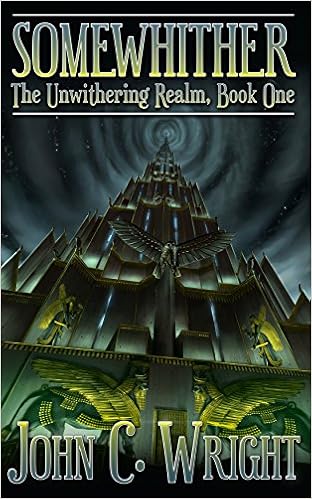
Review: Somewhither, by John C. Wright

After reading the preview of the first chapter on Wright's blog page, I couldn't wait for this book to come out. Now, I can't wait for book two.

In the first chapter, Ilya goes to his dad with a question that must be answered, expecting the usual brush off response. He's one of those dads that seems aloof, non communicative, but demanding of obedience, with high expectations of a top notch highly disciplined fighting machine at the end of a program of rigorous training that he puts his sons through. Training for what...? That's part of his dad's secretive nature. But hidden somewhere in that dense forest of hardwood is actually a fatherly heart that cares. So, Ilya expects a brush off response, and he appear to be getting just that. He probes for more, while his dad probes him in return for the intent of the question. Then, suddenly, his dad springs to his feet, barks out a series of orders, inducts him into the order of the Knights Templar and Ilya's childhood is over. That's not a spoiler, I hope. It's only the first chapter.

I also can't wait for the last book in the series, because I want to see his dad's response to the long tale that Ilya is going to report to him.

In the course of the story, Ilya makes other discoveries about himself. I like stories where there are hidden facts about oneself that are to be discovered, like Harry Potter finding out who he really is, and Frodo realising that that old ring that's been sitting in the top drawer of the desk all this time is, in fact ... -- well, you get the picture. There are some pretty amazing things to be discovered about Ilya as well.

The premise of this story is the answer to the question Ilya went to ask his dad in the first chapter, "How many universes are there?" Some proponents of the Many Worlds Interpretation say there's one for every atomic particle that ever made a wrong turn. According to Wright, there's one for every time God changed the course of history by whatever act he did, whether it be bringing the world wide flood, confusing the languages, delivering the children of Israel from Egypt (I could go on, but some of them could be construed as spoilers) -- there's always a world that splits off in which that didn't happen.

I finished the book, thinking it was awfully short. I went to the Amazon Kindle page so as to check the size of the book, and to my surprise, it was 590 pages!

Anyway, although I did grimace at some of Ilya's boyish ways and his occasional thickheadedness, it was a page turner (or in my case, a screen swiper). Like I said, I'm waiting for the next one...

Click on the cover image above to get to the Amazon page.
Hello again.

I've been away from this blog for too long, and now I've decided to make a new half-way-through-the-year's resolution to get back on it, and try to be more regular. I do have a number of things that could have been going on it, such as some book reviews, which I'll post in a minute.

But first, let me announce that Pepe is now a free download, in return for signing up for a newsletter. Here's where you go to sign up. Just click on the cover image:

http://www.robbycharters.co.uk/pepe.php

...or here: www.robbycharters.co.uk/pepe.php

Tuesday, 30 April 2013

The Memories of Geoffrey Hughes

I've just completed a short story, which you should be able to read here.

I suppose you could call it a cross genre Science Fiction / ghost story. It's not a horror story, not into things like seances or occult, just includes a wee ghost. I think you'll like it.


Wednesday, 20 March 2013

Websites and Domain Names

I've got two new websites. One isn't so new, but I just never got around to posting about hit here.

The not so new one is, www.Robbys-eBook-Formatting.co.uk, which is my business website, selling my services as an eBook formatter.

The newest one, just published with my new domain name today, is www.RobbyCharters.co.uk, which is technically also a business website, but selling my books. That also will have the list of where to find all my stuff online.


Saturday, 19 January 2013

Do Christians Love Guns?

...that's the title of a recent blogpost and newsletter by Andrew Strom. Find it here.


My first comment on it was, "I agree with you 100%, but I’m afraid you’re in for an avalanche of email every bit as big as the one you got for “Tea Party”"

When I went to hit the "Post" button, the site hung. I thought that was my prediction suddenly coming true, with the sudden avalanche of comments coming in. I finally got mine in later, and proceeded to view some of the comments. It's quite clear to all that just because one receives Andrew Strom's newsletters and frequents his website, isn't an indication that one agrees with him 100%. In fact, predictably, even though "Pasivism" wasn't mentioned in Andrew's article, nor even alluded to, that quickly became a hot topic on the comment stream. Here's one:

A question for all you pacifist Christians. If you were in that grade school, there was a gun on the table next to you and you heard the screams of people and gunshots. Would you leave that gun on the table and say, “violence is not Christian!” and continue to let dozens be killed?
The way to stop a bad person with a gun is a good person with a gun
 The one just before that was a very long one, probably worth reading to get the jist of the anti-pacifist view. However, all that wasn't the point of Andrew's post.

Here was my longer post:

I posted my comment above, and THEN looked at some of the earlier responses…

I don’t think Andrew is saying that it’s wrong to stand against injustice with use of force. It’s just not the Christian mandate. The police and the military, after all, use force to do many of the same things mentioned above. They’re not in violation of God’s laws. Even a revolution might be in order at times, but don’t mistake it for the advancement of the Kingdom of God.

As for the example of David and Goliath, above: The Jewish people had (or still have — depending on your theology) the mandate of maintaining a nation in the land God had given them as a part of God’s covenant with Israel. Christians, under the New Covenant, didn’t receive such a mandate. We’re called to support those in power, especially those who enforce justice.

Now, as to the question, what should we have done during the early Nazi period in Germany, or whether to use a gun to prevent a greater disaster etc etc. …

Is having an easy answer a mark of Truth? Is any one approach automatically the right one for every situation?

I see, in the reigns of King David and King Solomon, a scriptural basis for both passivism and non-passivism. David fought many wars to establish the Kingdom of Israel all the way to the borders God had promised to Moses. He was 100% in God’s will in doing so. However, in doing this, he was a “man of blood”, and therefore wasn’t granted the privilage of building God’s Temple. King Solomon, a “man of peace”, was called to do that, and Solomon’s reign, in stark contrast to David’s, was an era of peace.
Picking up a gun to shoot someone, even to stop a school shooting spree, is a position I hope I’m never thrust into. We could, for the purpose of argument, say it’s a sin. However, the rabbis have an argument based on the degrees of sin — the breaking of a lesser commandment instead of a greater one. A destitute woman has a child who is starving to death. To allow the child to die when it’s possible to save his life, would be a sin equal to murder. The commandment prohibiting murder is one of the greater commandments, whereas the commandment against stealing is one of the lesser. Therefore, the woman would be justified in stealing food, thus committing the lesser commandment, in order to keep from committing the greater one — allowing the child to die.

We’re called to be perfect, even as He is perfect, in a world that is anything but perfect. There are, therefore, no easy answers.

So, to sum up, I don’t think it’s necessarily wrong for Christians to own guns, and engage in politics, but not as a part of the Christian mandate. Neither do I believe pacifist are out of order.

In fact, I’d say I’m a pacifist.

Tuesday, 14 August 2012

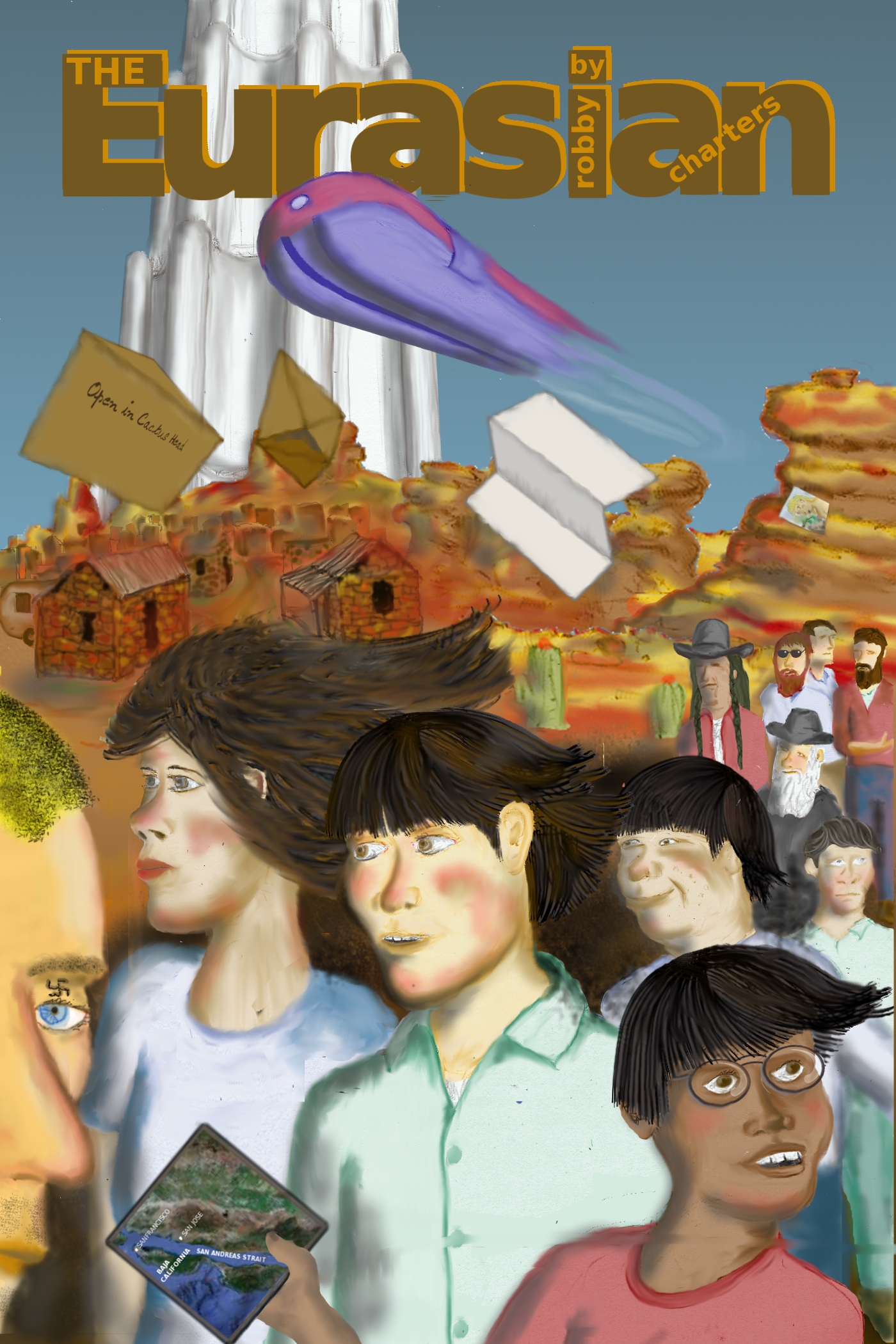
New Release: The Eurasian

A few days ago, I released my novel, The Eurasian, which I have been working on for over two years. It's my fifth full length one, and I suppose it's too early to judge if it's my best. It took the longest to write, because some parts were difficult. Some of the settings were rather daunting, so I had to take long breaks from it to let it settle, and come up with more inspiration and do research. I hope I've done a good job.

Right now, it's a free download at Smashwords.com, and $0.99 at Amazon Kindle (they don't allow me to make it free there).

What follows is the longer description:

The world of the late 21st century is divided between Greater China, the Western Block, the Islamic Block and the Southern Free States of Africa and South America. The Western Block is dominated by the multinational corporations, who have created a paradise for its citizens -- so everyone thinks.

Mickey O'Brien is the Eurasian, half Asian and half Irish. He has a problem with that, because all his friends are fully Asian. However, no one has actually met each other -- only their virtual projected images they show on their on-line classroom environment. He and his classmates meet each other for the first time as they go on a class trip to America. It turns out they all had things to hide.

In America, they accidentally discover what the Multinationals have been trying to hide. Their hover van is hijacked, and they are left trapped in the great American outback, a vast area of what was once U.S.A., now divided between countless republics. Some are Nazi, some are militant Christian and other redneck cowboy states, some Native American Nations, Mafia kingdoms, etc etc. The wild west is again wild. Once having stumbled in, can they ever find their way out again?

It's a story of finding out what's real, and discovering true faith as they become involved in an espionage war trying to prevent a Nazis takeover.

Friday, 27 January 2012

Review of J. A. Konrath's novel, "Origin"

One author who has become famous for being self-published, and yet best-selling (thus, giving hope to humble(?) authors like me), is J.A.Konrath. I found one of his books available as a freebee the other day, read it, and then reviewed it. Here is my review:

a technothriller cum horror, January 25, 2012

By robby charters

This review is from: Origin (Kindle Edition)

I found it a good read. The prologue was intriguing -- a bit of history that brought to mind the beginning of the film "My Science Project", also involving a president. This wasn't a copy of that, though. The first chapter -- the one where you're wrenched into the present -- was well done, with the presidents men knocking at the door at 3 a.m. Then, the setting opens up to us bit by bit through the eyes of Andy the linguist, before moving on to other narrative points of view.

He and eight others are the only ones, outside of the President, and possibly a few others who were sworn to secrecy (like ex-presidents, presumably), who know about the creature, allegedly the devil himself. At least he looks like the classical depiction of the devil. Through Andy's expertise, they get the creature talking. He's ancient. He knows Latin, Hebrew and Mayan, but he quickly learns English. His actual history is illusive, as we never know whether to believe the creature or not.

The other characters are a mixture. Sun, the vet, has recently been called in to check the creature's health. There's a priest and a rabbi. As one who has had exposure to both religions, I can say they're believably portrayed. Joe Konrath has also done enough reading up on things like ancient languages and DNA to at least sound believable. The narrative is spiced up by the banter between the rabbi and priest, chemistry between Andy and Sun, the secret desires of the doctor, and the hidden histories of each one (enabling the President to blackmail them into staying put), in an underground world equipped with everything only the army would think sufficient for the good life. He takes us from what seems like a science fiction techno-thriller, to what could pass as a horror story.

The story kept me glued til the "uh-oh" ending.

Robby Charters

author of Pepe

Author, in a shameless act of self promotion, review his own book


Here's a review I did of my own book, Pepe, which I just had to take down from its Amazon page because an author isn't supposed to review his/her own book:

Author, in a shameless act of self promotion, review his own book,

June 10, 2011

By

robby charters

This review is from: Pepe (Kindle Edition)

Okay, I'm the author. I understand it's probably not fair for the author to review his own book, but the Amazon environment appears to be letting me do so -- so I'll just ramble on a bit...

So, as the author, am I really an authority on whether YOU'll like it? I'll only say this. I have about about eight novels, novellas, shorts -- whatever -- available on Amazon, and in my opinion, PEPE is my best one. It's certainly better than THE WRONG TIME, which appears to be getting the most downloads right now.

It's a cyberpunk novel -- perhaps a bit of crossover to fantasy -- set in 2020. Pepe is a homeless street boy who doesn't know his true identity. In the course of the story, he lives in places you'd typically find them: before the fire, in a vast slum community named the Dockyards (which is one of the central locations); later, an abandoned multi-story construction site with other homeless kids; and then, a shelter for homeless children, Mercy House, which I've based on Mercy Centre, Bangkok, where I worked for a year. Everywhere he lives, he has his sister, Po, with him. She's two years younger, she's not his biological sister, but he knows he's gotta take care of her. I've described the life of street kids as closely as I can without making the story dreary and dismal. There's every type: Pepe's and Po's "grandma" died when their home was burnt in a slum fire; there's Jose, the drug addict, who ran away from an abusive dad; and Raquel and her six-year-old twin brothers, Pierre and Michele (don't worry -- no tiresome comedies-of-errors). Their mother abandoned them after their dad went to prison. They are French/African. Raquel is a colourful character. I loved doing her.

The story is set in the fictional Southern European nation of Cardovia, with a history that goes back thousands of years. Cardo, the founder and first king of the dynasty, once paid a visit to King Solomon and received a special gift from him. This, and the character of Atsuko, the aged Japanese mystic, give the story its fantasy edge.

...And it's Cyberpunk: The blurb above said that the General's brain had been wired to a network of computers and robots. You'll see that that can definitely have its disadvantages. Unbeknownst to his dad, Raul is a hacker. His dad is an army colonel, one of the General's top commanders. Their family is typical upper-crust -- the opposite end of the spectrum from Pepe and Po. Things get precarious when Raul hacks into the Generals computer system and realises what kind of person he really is.

Rich kid meets poor kid: We see the typical attitude of rich kids towards "low-lifers", but things happen. A relationship slowly develops until Raul, Pepe and Po are the closest of friends. He enters their world as one of them. At the same time, in front of his computer terminal and VR set, sometimes accompanied by Pepe, he makes discovery after amazing discovery. Puzzle pieces begin to fit together, until suddenly he realises the danger Pepe is in. In fact, it might be too late...I'll stop here. I'm giving too much away.

There are no superheroes. Everyone's thoroughly human. Perhaps the closest thing to a superhero is Atsuko, but even he has his limitations. But, everyone does what it takes to give the story an ending that should be thoroughly satisfying.

I think you'll like it.

Well -- (as Mr. Bean says about his videos) -- I like it anyway...

Robby Charters, author of The Zondon