Wednesday, 3 February 2016

Farmer Giles of Ham Farmer Giles of Ham by J.R.R. Tolkien
My rating: 5 of 5 stars

A hero on his own terms

Lovers of Tolkien's books on Middle Earth could do well to take a break and relax with a story that he told to his children at bedtime. This story takes place in the "Middle Kingdom" of old England, when the Island was divided between various small kingdoms, dragons and giants ruled the north, and choices of a weapon ranged from enchanted swords to a blunderbuss. Oh yes -- and dogs could talk, though their vocabulary was generally restricted to the vernacular.

Farmer Giles is a humble farmer who just wants to get on with business at hand, which is to bring in the crops, keep the larder well stocked and get a good sleep at night. His night time peace is broken when his dog, Garm, begins barking and babbling on about a giant that has stepped on his prize cow. So, Giles loads his blunderbuss and goes out to see what's going on...

And what's a blunderbuss?

"A blunderbuss is a kind of big fat gun with a mouth that opens wide like the end of a horn, and it goes off with a terrible bang, and sometimes it hits what you are aiming at." That's a quote from the second version, based on what Tolkien's daughter remembers of her bed time story. This edition contains both versions, as well as an unfinished sequel -- the first few paragraphs and some sketchy notes on how the story would have gone from there.

Back to the giant. The farmer falls over backwards as soon as the giants head appears over the hill, the gun goes off, and a piece of scrap metal from the barrel hits the giant on the nose. Being near-sighted, and having no clue that there are people living in these parts, he thinks it's a stinging fly, so he turns around and goes back home. Garm, the farmer's dog, runs through town announcing that his master has single handedly driven away the giant, and Giles becomes the hero.

That's just the beginning. Next is the story of the dragon, where Giles again becomes the unwilling hero. But hero he is, so he's a hero on his own terms, much to the chagrin of the king and the knights of the realm. Tolkien, a storyteller on his own terms, brings it to a delightfully satisfying "happily ever after".

Among my favourite characters is the dog, Garm. He's exactly what I imagine a dog would be if dogs could talk. The old mare and the dragon are also well cast. In all, it's a great read.

View all my reviews

Saturday, 2 January 2016

Israel had twins, their names were Christianity and Islam...

...perhaps not in the sense that we normally think; they were born 600 years apart. The elder twin, Christianity wasn't called by that name at first. It was the local street urchins and the bullies who began calling him that as a taunt. They kept it up for so long that soon he was calling himself that, and the name stuck.
At first, Christianity took after his mother, which meant he reflected the two divine attributes, Justice and Mercy -- also known as Holiness and Love. In fact, he reflected them so well that the mother became jealous, and he began to find it difficult to live in the same house with her. This was also due to the fact that Israel's husband had called, dressed as a beggar; and she, failing to recognise Him, had turned him away. However the son had recognised him, and they stayed in communication. He promised the child that one day, they would all be reunited.
As time went on, the son could no longer stand to live in the same house as his mother, and left home. About that time, the house was seized and the mother also had to leave. They became a broken family.
Cut off from his mother's influence, Christianity began to emphasise the divine attribute of Love and Mercy, neglecting that of Justice and Holiness -- receiving only the new and rejecting the old. He also began to emulate the neighbourhood boys in other ways, and was soon unrecognisable as the son of his mother.
This was truly sad, as the child had been destined to reign as a prince alongside his mother, a queen, and his father, King Messiah. This would bring perfect balance to the universe, however it couldn't happen, because the child who was to be prince was away from home, and his character was becoming increasingly unbalanced. Even as it was, the mantel of “Prince of the Universe” was still on the child, and as such, his imbalance also affected the universe.
What happened next was not the original plan of Him who was to reign as King, but it was as though nature were correcting the imbalance. He allowed it to happen, knowing that it would bring about his purpose in the end, and in the mean time, there would be a semblance of balance in the universe. So, because of the imbalance in the cosmos, a twin was born. Just as the older twin was the son of Abraham through faith, the younger was also a son, through Ishmael. That twin's name was Islam.
Everything that the elder twin rejected, the younger twin embraced. The elder child had clung to mercy at the expense of justice, so the younger twin clung to justice, but rejected mercy. The elder twin had become careless in describing the Holy Trinity, giving the impression that he believed in three gods instead of One God manifested as three persons. The younger twin responded with, “That's polytheism! There is only one God,” and rejected the Trinity. The elder child had begun to describe the doctrine of the Incarnation and Virgin Birth in a pagan sort of way, as though God had intimate relations with Mary to give birth to Messiah, thus His title, the “Son of God”. The younger brother was repulsed by this idea, and retorted, “No! God cannot have children!”
Never-the-less, the younger twin did believe in the Messiah, even acknowledging that He was the Word of God, not realising that that's what the term, “Son of God” really meant in the first place. But he didn't believe in the crucifixion and the resurrection, because those were the ultimate expressions of Mercy. In essence, he had rejected Mercy because his elder brother had so distorted it by divorcing it from Justice. However, his own understanding of Justice was likewise distorted.
It was truly a broken family, and all nature wept. The mother, having fled from her home and living wherever she could, was tormented and persecuted by both of her children – when they weren't too busy fighting each other.
Then, one day the first child had an awakening. He began to realise what a horrible son he had been, and began, by degrees, returning to his mother. The mother's heart also began to open to her son. The son asked her, “Please, remind me of the truths I've neglected this past 2000 years, like Justice the Fear of the Lord.”
As the mother began to open up to her child, her eyes also opened to King Messiah, whom she had once turned away from her door when he came dressed as a beggar. He had been communicating with the elder twin from a distance all along, but the child had not been very good at remembering all that he told him, and didn't know how to mix the new with the old. But now that the King was revealing Himself more directly, the elder son also began to think more clearly and understand the will of the King, and the divine attributes of Justice and Mercy.
Another thing began to happen: the more the older child embraced the more balanced view, his twin began to fade away as his soul began to merge with that of his older brother. Soon, they were no longer two separate twins, but one child. Only a shell of the younger twin's body remained, sort of like a zombie that continued to put up a fight until it disintegrated. There were also other zombies, clones of the mother and elder child that had spawned when the reunion came. For a short time, all the zombies joined forces in an attempt to devour the Queen and the Prince, trying to bring about a zombie apocalypse. That was short-lived, and soon total harmony was restored in the universe as King Messiah reigned with the Queen and the Prince for the rest of eternity.

Image: By William Fraser [Public domain or Public domain], via Wikimedia Commons

Thursday, 17 December 2015


Subtitled: Deep Healing Needed

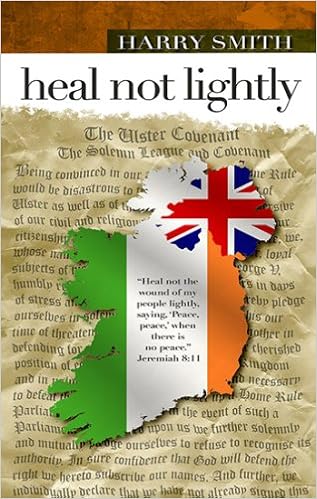
HEAL NOT LIGHTLY, as the title suggests, is a book about healing – not light healing that might be applied with antiseptic cream, or a sticky-plaster or band-aid, but a deep one, that might require the skill of a surgeon. More often than not, problems between ethnic groups fit into the latter category. This book takes a look under the surface of what have been called “The Troubles” of Northern Ireland, and Harry Smith finds a few areas requiring the deeper sort of healing.

One of these is the Ulster Covenant, which was the response of the Protestants of Northern Ireland in 1912 to the proposed Home Rule Bill that had been submitted to the British Parliament, and looked like was going to become law. This would have placed all of Ireland, North and South, under an autonomous parliament in Dublin.

This was good news to the Irish Catholic community, whose experience of British rule had been quite turbulent and often traumatic. However, the Protestants community in Ireland didn't share the same historical perspective. There were other issues.

Among the biggest was that such a parliament would have a Catholic majority. The Protestant community who had migrated to Ireland in large numbers during the times of Queen Elizabeth I, James I, and William of Orange to serve as their political pawns, would suddenly find themselves in the minority. It was rightly believed that the Dublin government would be heavily influenced by the Catholic Church. A common slogan was, “Home rule is Rome rule”. If that seems far-fetched, remember that religious freedom was not taken for granted in Europe then as it is now. Also, those were the days before the Vatican II council, which liberalised the Catholic Church's position towards non-Catholics (however, even now, there are many Protestants who regard these changes as strictly cosmetic).

So, many Protestants feared the worst. The Protestants of Northern Ireland, primarily under the leadership of the Presbyterian, Church of Ireland and the Methodist churches, banded together and signed a document called the Ulster Covenant. In this, they swore not to submit to Home Rule, and in the event that it was forced on them, to resist, taking up arms if necessary. Some prominent Ulster Protestants signed it with their blood. This covenant has been the basis of Northern Irish identity ever since.

The first chapter of the book contains numerous statements in the press by various church leaders, politicians, editors and others regarding the danger that was eminent, and the necessity of every Protestant who values his history and his freedom as a British subject. Just reading them gives one a sense of the atmosphere that prevailed. In all, around 250,000 men signed the covenant – with a similar number of women signing a supporting document.

Harry Smith also goes into some more background, relating how former Moderators of the Presbyterian Church in Ireland utilised the Scottish National Covenant of 1638 to unite people politically and spiritually against the Home Rule Bill.

The Scottish National Covenant was a vow of solidarity, which established Scotland as a Christian nation under God with their Presbyterian values, in their resistance to attempts at control by the Church of England. In effect, it was a reminder to God whose side He was on. It was even said that in the same way that God had once regarded the Israelites as His chosen people, whom He had now rejected under the New Covenant, He now regarded the Scottish nation. In other words, Supersessionism, or Replacement Theology was a cornerstone of Covenant terminology.

Then, we read details of how, during the times of James I and William of Orange, Scottish Protestants were offered land in Ireland from which Irish Catholics had been forcibly removed. They regarded this as their divine mandate, and that later became the basis of the Ulster Covenant.

So, whose side was God on? Reading all the press statements in the first chapter compels one to consider that a covenant may have seemed like a good idea at the time. In fact, one would have been considered a traitor – an enemy of God – for opposing it. But was it really a good idea? The song by Bob Dylan, “With God on Our Side” comes to mind.

Harry Smith believes that the Ulster Covenant is now one of the biggest hindrance to peace in Northern Ireland.

But, you ask, didn't the Good Friday Agreement bring peace? There still exist huge fences crossing whole sections of Belfast, which are referred to as the “peace wall”. They are, in fact, proof that there isn't peace, otherwise, why would we need walls to separate us? That actually fits with the same passage in Jeremiah 8:11 from which Harry Smith took the title: "They have healed the wound of my people lightly, saying, ‘Peace, peace,’ when there is no peace."

God showed Harry Smith that it is like a log-jam that holds back the flow of His Spirit - like the river mentioned in Ezekiel chapter 47, which brought healing to the land. Repentance at Church government and personal levels are essential for the removal of this log-jam so as to release the river of God.

To achieve peace in Northern Ireland, Protestants in Northern Ireland must renounce the Ulster Covenant, and the Nationalist community must renounce the Sinn Fein Covenant (that was signed a few years later); let go of our political agendas, and trust God to direct the future according to His plan.

There are also chapters on intercessory prayer, a helpful exposition on the basis for believers' authority, and many practical guidelines on how to seek God's plan for a city or a nation, with particular emphasis on Ireland. Even if it were just for those aspects, it's a worthwhile read.

If you're interested in ethnic reconciliation and want to understand more clearly, what you're up against, definitely, get this book.

Friday, 11 December 2015

Subtitled: Humanity Can't Be Trusted

It's classical science fiction. I read it in 1969 when I was about 13 years old, but re-reading it now, I realise how much of it was away over my head. Not only has my head changed since then, but so have the times. Yet, the message comes out very clear in a way that only became popular later on: Humanity can't be trusted.

Robert Fairlie is an expert in languages, ancient and modern. He has been asked to help with a project for what he thought was the Smithsonian Institution. Instead, on disembarking at the air terminal, he's picked up and driven to a top secret facility in the New Mexico desert.

I suppose you guessed it -- it's a pre-Neil Armstrong we've-landed-on-the-moon story. On the moon, they made a shocking discovery: someone's been there already. Thousands of years ago, actually. There are the ruins of what was a space port and evidence that it was destroyed in an attack. Enough relics are found to enable scientists to recreate one of their space ships, but no one understands how they work, or where they're from. There's documentation, but in a totally unknown language. Also, voice recordings that play back on a strange machine they happened to find in one piece. That's why Robert Fairlie and other linguists were drafted.

Deciphering a language with no known references is nearly impossible. Almost ready to give up, Robert tries one more idea that has been plaguing him. Some of the syntax of the language reminded him of ancient Sumerian. He follows that lead, and sure enough...

The ancient astronauts are the ancestors of humanity -- Earth humanity, that is. Humans didn't start on Earth. What's more, they locate the original planet of humanity. Now able to read the how-to manuals, they get the ship into working order. The bulk of the narrative is the trip to a planet across the galaxy. Of course, Robert Fairlie has to go along, as someone has to talk to the people there.

One question remains, which is why the project seems so urgent. Who destroyed the base on the moon? Who was the enemy even more advanced and high tech than the ancestors of the Sumerians?

Before it became a Hollywood scriptwriter's cliche, Edmond Hamilton characterised DeWitt as the military heavyweight who's going to run roughshod over any obstacle to American interests. Christensen is the more level headed scientist who knows that there are more important things at stake. If it seems like an old and dusty scenario, give him the benefit. It was a much more fresh and daring thing way to express when Edmond Hamilton wrote it in 1960. When I first read it, America was still the good guy, playing the hero in Vietnam, "with God on our side". Military men were always depicted as knights in shining armour. Think John Wayne. Contrary to one of the other reviews I've read on the Amazon review page, it wasn't a tired cliche when Hamilton wrote it.

As it is, Hamilton presented a very well narrated story of human imperialism then and now. Who destroyed the base on the moon? Someone who knew that humanity couldn't be trusted.

Monday, 16 November 2015

Review of Iranaeus' The Proof Of The Apostolic Preaching

Subtitled: Towards a much more simple and basic theology
Find it hard to get your head around Calvinism, Armenianism, Original Sin, Predestination and other focal points of Augustinian theology? Try simplifying things by shifting your focus to much earlier in history -- the time of Irenaeus.

Mind you, St. Augustine was a deserving of the honour of sainthood. His dedication and devotion to God are exemplary, and his testimony of his conversion is a great inspiration. The story of his mother's dedication and unceasing prayer is especially inspiring.

But his Bible teaching....?

St. Augustine lived in the fourth century, was heavily influenced by his Greek style education -- though he never learned the Greek language. In other words, he based his theology on the Latin scriptures (with all their translation errors), and used his Greek style reasoning to interpret it. Many of the doctrines that he passed down to us, we are hard put to find in the writings of earlier Church Fathers.

St. Irenaeus, on the other hand, lived in the second century. He was well versed in the Greek scriptures in their original (or closer to the original) texts, but interpreted it in the Hebraic style rather than Greek. In fact, he was the pupil of St. Polycarp, who was the pupil of St.John.

A great piece of work is St. Irenaeus' THE PROOF OF THE APOSTOLIC PREACHING. He goes systematically through what the early believers had received directly from the Apostles. Free will vs determinism wasn't even a question yet. Original Sin isn't mentioned, nor alluded to. Instead, the emphasis is on death and resurrection. Sin -- or disobedience -- resulted in death. Jesus came to bring life, and the resurrection.

Overall, you'll be edified by a challenge to walk the life of faith, worded in the simple language of the earliest believers.

You can read it for free at www.tertullian.org/fathers/irenaeus_02_proof.htm
Or download a copy here: www.ccel.org/ccel/irenaeus/demonstr.html

Thursday, 12 November 2015

Review of John C. Wright's City Beyond Time

Subtitled: Time and Space Gymnastics

John C. Wright is one of the best I know at spinning a yarn out of the fabric of space and time. This is a set of short stories that are all based on universe of Metachronopolis.

Metachronopolis is the city at the end of time. It's where time travellers live, referred to as "time wardens". They're the ones who keep things organised -- well, at least they're supposed to. Like police in many parts of today's world, a lot of them are corrupt and self seeking.

They're not the only ones there. Just about every famous personality in history is also there. The time wardens are capable of showing up an instant before a person's death, and replacing them with a dead clone of themselves. It happens in a split second, so no one sees it happening. In other words, that wasn't John F. Kennedy's body you saw being rushed to the hospital on that momentous day in 1963, but his clone.

In each tale, Wright does a different acrobatic stunt, each with an unexpected twist on time travel. They're all stand alone stories, but the last sort of ties the whole concept together by showing us what it's really all about. A Christian that John Wright is, there's a profound lesson in each one.

A must read...

Wednesday, 11 November 2015

Review of Sean Sanborn's Rescue: Book one of the Naga Trilogy

Subtitled: Not the Typical Missionary Tale


Link to eBook Edition

I can relate to Chaz, because I was also a missionary's kid, spent time in Chiengmai, have frequented some of the same haunts and can practically taste the various foods as they're mentioned. But that's not why I'm giving this book five stars.

Chaz is 13 years old, lives with his parents and two sisters on the outskirts of Chiengmai at the foot of Doi Suthep, near the university. Many tourists and world travellers will know exactly where I'm talking about. It's the beginning of the summer holidays and they're expecting a team of young people on a mission trip from America.

So far, does this sound like a typical boring missionary tale?

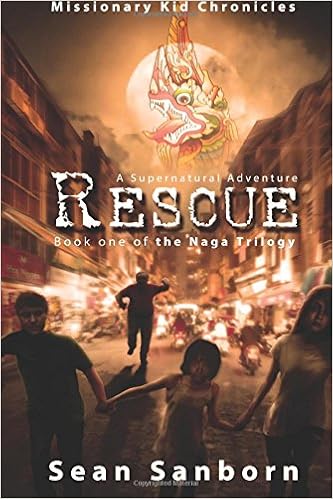
That picture on the cover says otherwise. That's Chaz and his friend, Ashley holding the hands of Katya, the little girl in the middle, running down a street near the Night Bazaar. Chasing them is a European man who has bought the little girl's “services” for the night. On an impulse (maybe it was God's voice?) Chaz had grabbed the little girl and ran.

Not pictured on the front cover is the local Chinese Mafia warlord and his men who don't take lightly to their young prostitutes being snatched away like that.

Katya is a nine-year-old tribal girl. The book opens in the Karin village with her aunt and uncle warning her she must take the canoe and leave, and never come back. A little later, she finds out that the spirit doctor and the other villagers plan to sacrifice her to the Naga who lives in the river. That's the ornate snake-like dragon, whose head appears at the top of the front cover.

What exactly is a Naga? Is it mythological, or is it real? Is it a demonic power? Apparently, the creature will play a part in the story, but we'll have to wait for the sequel.

So, Katya fled to the next village, where a “nice man” offered to take her to the big city to get a job. Chaz and Ashley meet her on the first night of what would have been her new career.

For daring such a thing, the police tell Chaz that he's foolish, rash, and could have got himself and his family killed. But at least this particular policeman is cooperative – not like some I've heard of.

And Chaz's dad, Nick, is not your ordinary dad, even for a missionary. Does he scold Chaz for pulling such a stupid move? Does he ground him for a week, and drill some sense into him, like a responsible parent would have done?

Well?

What would David's dad have done had he known he was going out to fight Goliath? What about Jesus' parents when he stayed behind at the Temple? You get the idea. Nick's response was, “I don’t like how it all happened but I have to agree with Chaz. I think in this instance we did a good thing in helping the girl.”

But the Mafia people aren't happy, and there are consequences. They meet again...

A day or two before that, while sitting in an ice-cream shop, Nick had described to his three kids how to listen to the voice of God. Basically, it's to do with getting away from distractions and hearing “the still small inner voice of God.”

Chaz begins to get the idea. The plot moves onward on the strength of the “still small voice”. Once it leads to the decision to make a trip to Katya's village (which will happen in the sequel). Another time, it saves Chaz's life. To say how would be a spoiler.

There are other aspects to the story as well, for instance, the mission team that's visiting. On the team are various sorts, including Ashley, for whom Chaz develops a crush; and Brandon, the boy with the attitude, who's only on the trip because his parents promised to buy him a motorbike. Things get into a tangle.

Not all the loose ends are tied together. This is only the first in a trilogy. The sequel will be the trip to Katya's village, all because Katya believes that if Jesus is all-powerful, he can defeat the Naga.

I'm looking forward to it...

Sunday, 8 November 2015

Flash Fiction: Little Red Riding Hood in historical context

Little Red Riding Hood knocked on the door of her grandmother's cottage. A gentle voice inside said, 'Come in, dearie.'
Little Red Riding Hood pushed the door open and carried her basket of treats across to the bed where her grandmother rested. She stood there and gazed at her grandmother.
'What is it, dearie?” coaxed her grandmother.
'Grandmother, you do have very big ears. All my friends grandmothers don't have nearly as big ears as you do.'
'All the better to hear you with, my dearie. I'll bet none of them could hear nearly as well as I do.'
'Yeah,' acknowledge Little Red Riding Hood. 'I just about have to shout to get them to hear me – but – Grandmother, what big eyes you have!'
'All the better to see you with, my dearie! All the other granny's are blind as bats, I bet.'
'Yeah, they are – and Grandmother, what a big nose you have!'
'All the better to smell with! Why, I knew you were coming when you were yet a mile away!'
'And what big, sharp white teeth you have!'
'Yes, I keep them white and sharp by chewing on bones. Now, let me see what you have there.' She lifted the cloth on the basket. 'Ahh! My favourite! A loin bone, oh! And a shoulder bone! Ahh, full of lovely bones. You must have had a feast! Thank your mother for me, won't you?'
'I will, Grandmother.'
There was a knock at the door.
'Go open the door for you uncle, will you, Riding Hood,' said Grandmother.
Little Red Riding Hood opened the door, and there stood a big burly wood-cutter.
'Uncle Remus!' cried Little Red Riding Hood, joyfully.
'How's my favourite niece!' he said as he swooped her off her feet. 'And how's my dear mother?'
'As well as can be expected, I suppose. Your sister-in-law sent me these lovely bones.'
'What a sweet gal she is, my brother's widow. Speaking of Romulus, I could have certainly used his help on this project.'
'Yes,' sighed Grandmother. 'It's too bad about his “accident”. That was shortly before Little Red Riding Hood was born. But it's certainly good of you to name the new city after him.'
'If it ever gets finished. At this rate...?'
'Rome won't be built in a day!' said Grandmother.

Thursday, 5 November 2015

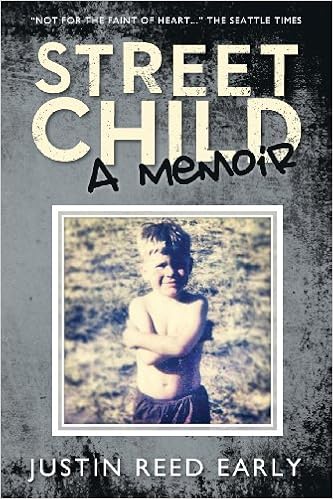
Review of Justin Reed Early's Street Child: a Memoir

Subtitled: Surviving Streetwise

I said it before in my review of Jo Napoli's The King of Mulberry Street: there should be a new genre added to the list, called "street kids" or "homeless children". They'd cover the whole range from fiction to non-fiction. Included would be Charles Dickens' Oliver Twist, Fr. Joe Maier's Welcome to the Bangkok Slaughterhouse: The Battle for Human Dignity in Bangkok's Bleakest Slums (whom I had the privilege of working with in Bangkok), Robin Lloyd-Jones' Fallen Angels: Stories of Los Gamines, as well as my own Pepe. Certainly not least in this line-up is the one I just finished reading: Justin Reed Early's Street Child: A Memoir.

As the title suggests, it's Justin's own story . The first two chapters cover his own life as the third son in a middle class family in Washington State, his tumultuous relationship with his father (it's hard to imagine a worse father than Justin's, a very unhappy man indeed!) which led to his leaving home at the age of ten, his entry into the world of foster car and youth homes, and finally his escape to street life.

Street life seems glamorous, perhaps for the first few years. He meets the right people, street kids like himself, but mostly older. Roberta and Frankie become his closest friends. Because he's so young, everyone takes care of him. He quickly finds that the most lucrative means of support is the sex trade. At his first pick-up – “trick” is the local slang word for it – Roberta warns the customer that her friends are watching, and “no penetration”. He gets picked up by the police a few times, and even sent to a youth facility far off on the other side of the state. He escapes, and as a “cute little boy”, he has no trouble getting back to the streets of Seattle. Someone even buys him a plane ticket.

One only remains a “cute little boy” for so long, and after that, life isn't as easy. While life as a street kid may have its romantic side, Justin Early holds nothing back in showing the consequences such a life can lead to. The chances of surviving into adulthood are much less for a child of the streets, especially when there's a serial killer on the loose – and the AIDS epidemic – and the suicide rate...

One of the events that Justin describes is the filming of Streetwise. When I got to that part, I did a Google search and watched the whole feature-length film on YouTube. I understand it was a popular film in its time – it was nominated for an Academy Award – but I had missed it. In one of the opening scenes, I recognised Justin standing next to a phone box with Roberta, from one of the photographs in the book. Other than that, Justin doesn't show up much in the film, because Frankie had warned him to stay away from people with cameras. However, many of the characters from the book are remembered in the film. Lou Lou is the one you see loudly threatening anyone who would abuse her fellow street kids. In the book, she chases away a would-be pimp, and in the film, forces an older tramp to apologise to one of her young friends. She's Frankie's sister and Roberta's lover. Then, there's the tragic story of Dewayne. It would be a spoiler if I said more...

If you do read the book, you'd be missing out if you didn't watch Streetwise, at least the YouTube video:
.

As I said, this would fit into my proposed “Homeless Children” genre. However, all Homeless Children books would necessarily be a sub-genre to others, like Science Fiction as in the case of my Pepe, or Classical Fiction in the case of Oliver Twist. This one, of course, is a Memoir, but it could also be classed in yet another genre, GTLB, due to the permanent effect Justin's street life had on him. It wasn't the sexual orientation of his choice, but too much had happened, and the last part of the book describes how he came to terms with it.

It's also not how I would have hoped it would turn out. To be up front, I'm a Christian who believes that being Gay isn't God's plan for human relationship (but please keep that in perspective: nor do I believe that a heterosexual relationship outside of wedlock or with multiple partners is God's plan. Nor, do I believe, is gluttony or alcoholism. But I have friends who are all of those, whom I respect and enjoy being around – when they're not doing those things. We've all been broken in some way or another). It doesn't keep me from enjoying a book like this, and highly recommending it as an eye-opener to what really happens on the street.

It happens in America, even in pristine cities like Seattle Washington. Granted, a slightly larger percent of the street children there are from dysfunctional middle class families. Fewer – though still some – are abandoned. Dewayne had run away from a foster home and was waiting for his dad to be released from prison. Also, apart from the occasional serial killer, the streets of Seattle are probably a bit safer than places like Brazil, where the police have been known to round up street children and shoot them. But the streets are still the streets, kids are still kids, and life can still get ugly.

For Justin, it was ugly, but with a happy ending. There's a lot about forgiveness, and his last moments with his dad are happy ones. Justin now has a career in helping to improve the lives of other kids like himself.

That's not a spoiler – he did, after all, write this book himself....

Wednesday, 28 October 2015

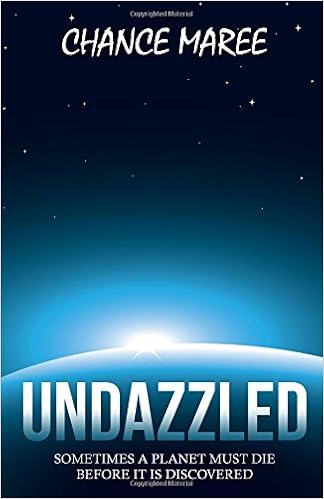
Review of Chance Maree's Undazzled

Subtitled: Planet of the – What?

As the planet Earth is dying, it appears that we've come full circle. We're again using beasts of burden for transport. However, these aren't earth hugging camels and mules, but space travelling “worm-moles” – so named because they bore worm holes to distant parts of the gallaxy. They're gigantic creatures, and they wear what would make up the rest of the space ship, like a collar. How were they discovered? Hold that question for the last and climactic chapter of the book.

The people best equipped to pilot a worm-mole are upper middle-aged women, dubbed “crones”. A part of the worm-mole's brain extends into the bridge deck like an easy-chair, and the “crone” sits naked in it as it engulfs her body, except for her face, so she can communicate with the creature through her skin.

Pots Khan-Anderson is a crone, who pilots Alpha Horizon – “Alphie” for short. Earth is dying, and the race is on to relocate as much of humanity as possible (or a chosen representation thereof) to three habitable planets in a different part of the galaxy. These planets are thought not to be already inhabited by intelligent life. The Alpha Horizon is taking the first load.

Something very surreal begins to happen along the way – in fact, very weird – which almost gives the story a fantasy edge. Then, when they arrive, they discover, they aren't alone. Another race, closely approximating humans, inhabits the planet – a primative tribe not much different from Native Americans (at least that's how they struck me as I read it). In fact, because of the surreal thing that happened along the way, they look more human than the newcomers.

There are a number of narrative points of view, each told in the third person. Each chapter is named for the POV. The first is Pots, followed by the commander, Gunner Dovmont, and then the teenager who is thought to be his son, Tyr Dovmont. Among later chapters are Ata, a pre-teen girl, a native of the planet.

Commander Gunner meditates on Taoist proverbs. Each chapter contains at least one quotation. Despite that, he's the villain. We find out early in the narrative what he intends to do about the native population – but not so early that telling you wouldn't be a spoiler. But from the first, we see that he and Pots definately don't get along. Since Pots isn't military personel – rather works directly for NASA, which has become privatised – that's okay. Montalbam, the captain of the Alpha Horizon is her boss. Commander Gunner's command is over the actual settlement on the new planet.

Tyre is a hybrid human, the product of an experiment that had to be aborted when the public found out about it. The other young subjects, believed not to be human, had to be put down. Gunner knew the doctor in charge of the project, and managed to keep Tyre for his own purposes. However, we soon find that Tyre, though a deadly weapon in the wrong hands (namely Gunner's), does have feelings and a mind of his own whenever he has control over his own actions.

Those who understand the history of Native Americans and the rise of the U.S., will get a lot out of this. While Gunner and his colleagues seek to avoid some of the same mistakes, things still go awry – human nature hasn't changed. There are the same questions: Whose land is it? How can we co-exist when earth-human survival is the priority? Plus a few more: Who are the fabled “people in the canyon”, whom the local tribesmen threaten will squash the newcomers like vermin if they infest the land? Are they no more than a local legend, or is there something more...? And that surreal effect I mentioned earlier...

Chance Maree handles her characters very well. One of my favourite scenes is the screening of The Planet of the Apes on the new colony. Things have happened, people are upset with each other for various reasons, and Chance masterfully plays two or three conversations at once while keeping us aware of what Charlton Heston is doing during the opening scenes of the film.

Over all, a good read. I give it five stars.

Thursday, 22 October 2015

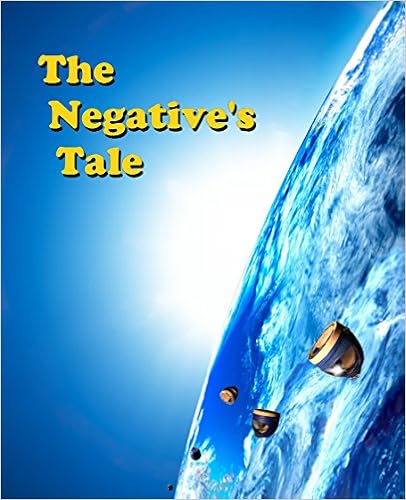
Review of R. Leib's The Negative's Tale

subtitle: brilliant fictional science in a tale within a tale

 
Allon Wu lives sometime in our distant future – far enough for people, having aged 300 with the help of their non-sentient clones, to have become bored with life – plus enough time for us to have developed that technology. Alternatively, one could figure in the time it'll take us to get around the barriers to faster-than-light travel, and then populate the farthest reaches of our galaxy.
The latter technology is one in which our protagonist plays an essential part, through his psychic ability. But first, let's start with how faster-than-light travel is possible to begin with: it's those factors that also make time-travel impossible, that are combined so as to complement each other, that make faster-than-light travel possible. When it's done right, computers can then be used to calculate the variables that will relocate the ship to anywhere in the universe – within certain limits. However, things can still go horribly wrong through various distortions in the cosmos, and that's where a navigators with psychic abilities comes in. Only they can detect those distortions so as to make the necessary mid-course adjustments. So, one or two such “navigators” are required for every interstellar flight.
Allon Wu's particular ability is rare. He's a dowser with negative orientation. As a “negative”, he's able to enter the mind of any psychic of “positive” orientation, and make use of their ability. His use of his ability as a dowser (finding things, or hitting on the right course of action) is also affected by his negative orientation. The right course of action is usually the one his normal intuition tells him is the most unlikely, so he has to learn act counter-intuitively – almost in a New Testament sort of way: becoming small in order to achieve greatness, losing your life to gain it, etc.
Leib's fictional science is brilliant. Not being a nuclear physicist myself, I don't know where the hard science ends and his ingenuity begins. Not having read every sci fi novel ever written, I don't know if anyone else has thought of this sort of work-around to faster-than-light travel – with the possible exception of myself (I used something I called “logical relocation” in one of my novels, but I didn't explain it in nearly so much detail – and I didn't use psychics).
The technical details are explained to 10-year-old Allon Wu by his aged instructor, Professor Billgore at the beginning of one of the two story-lines in this narrative. That's the other unique feature of Leib's novel; he's actually telling two stories.
The main story is the one in which the adult Allon Wu has been commissioned by his estranged wife, a Vice Admiral, to solve a suspected murder on board a space station cum city. The background story is told, initially through flash-backs, and then continued in the form of a story he tells his colleagues during pauses in their action – thus the “Negative's Tale”. The “tale” actually takes longer than the main story. It begins with a workplace accident that changed the direction of his career, then further back to the age of ten, when he began his education as a “second navigator”, then his romance with the Vice Admiral that began in the wake of his career change following the accident. The story he tells his two colleagues is of a trip to distant star system in pursuit of a murderous religious fanatic who has almost killed his admiral/wife, and is on his way to systematically kill more people. On this trip, he interacts with non-human extraterrestrials, which, interestingly, one of his old professors claimed didn't exist. Both stories come to a great finish.
Personally, I loved the innovative style of this book. I can see how some might prefer a more standard approach, but I loved it. Although there may have been a few non-standards glitches such as switching points of view in mid scene, a few over-long descriptions and a little bit of unnaturalness in some parts of the dialogue; the great story-telling carried it for me, so I'm giving it a fiver.


Monday, 5 October 2015

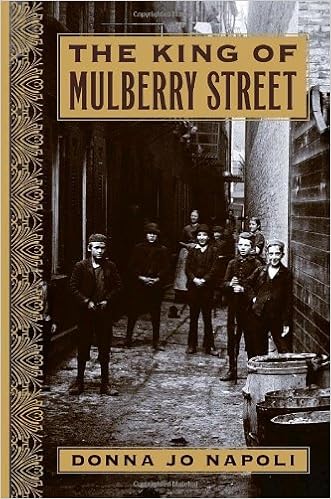
Review of Donna Jo Napoli's "King of Mulberry Street"

subtitle: Homeless Children as a Literary Genre
 
In my opinion, there should be a new genre added to the list, called "street kids" or "homeless children". It would be a sub-genre to others, such as memoirs and true life experience, for example, Justin Reed Early's Street Child: A Memoir which I've downloaded and plan to read next, Fr. Joe Maier's Welcome to the Bangkok Slaughterhouse, whom I had the privilege of working with in Bangkok; science fiction/cyberpunk, such as my own Pepe; or current or historical fiction, such as Charles Dickens' Oliver Twist, Fallen Angels: Stories of Los Gamines, and, definitely not least, Donna Jo Napoli's The King of Mulberry Street, which I've just finished reading. While accepting it as a literary genre, however, let's be careful not to romanticise it too much, remembering that these things really do happen to real children in many parts of the world.

Whether historical, futuristic or present, certain factors always remain the same. Human nature hasn't, and will probably never change. Cruel opportunists exited in Dicken's time, they exit now, and will exist in the future (judging by the way things are going). Examples include the "padrones" in Dom Napoli's late 19th century New York, where they helped children to emigrate, but kept them as slaves, working them on the streets. And what about futuristic technology? The street kids are too busy trying to keep themselves fed to worry about that, let alone afford any of it. If anything, it makes their lives worse. Street kids of all ages don't even wear shoes -- with the exception of Dom Napoli, whose mother thoughtfully bought him a pair shortly before sneaking him on board a freighter to America.

When I refer to Dom Napoli, I mean the main character of the narrative written by author Donna Jo Napoli. Dom, the character, is a nine-year-old Italian Jewish boy from Naples, and is based on what the author, Donna, imagines her own ancestor to be (who emigrated at the age of five). Like Donna's ancestor, Dom finds himself totally alone in America. He chooses the surname of Napoli because that's where he's from. He doesn't know a word of English, but he's heard that Mulberry Street is where there are people who speak Italian with the Napoli dialect. He follows a man whom he heard asking directions to Mulberry Street, until he arrives there. Maybe, he hopes, he'll find an uncle he knew to have emigrated there previously. He doesn't. Instead, he sleeps in an old barrel not far from a dead dog -- at least no one bothers him all night. But what next...?

Dom seems to be quite an intelligent and resourceful boy for his age, and he actually makes it, and becomes successful at selling sandwiches and helping out his friends. One might be tempted to think that the story isn't very realistic on this point, but it has happened before. At least the author's great-grandfather survived on his own as a five-year-old immigrant and, although the details of that are sketchy, did eventually start a similar business. One rule of writing fiction is, "Truth is stranger than fiction" – meaning that regardless of miracles that may happen in real life, fiction has to remain believable. Donna Jo Napoli, at least, kept this rule by making her main character a nine-year-old instead of a five-year-old.

In a street kid's everyday life, there are plenty of obstacles to overcome -- enough to fill up any literary genre. Life on the streets can be as dangerous as jungle warfare, or laser battles in an alien landscape. There's plenty of possible action to draw on. If anything, the writer's challenge is deciding whether he/she has made it too easy on the main character, or made life too dismal for the reader to enjoy -- I speak from experience. In reality, some people do survive a childhood like that, but in fiction there must be a balance between reality, believability, and maintaining it as a pleasant read. Remember, “truth is stranger than fiction (and must be kept so)”. On the other hand, I don't think any realistic story about homelessness can be told without relating at least one tragedy, as also happens in The King of Mulberry Street. Donna Jo Napoli has handled all these factors like a pro.

As historical fiction goes, Donna Jo also pulls it off well. Not only does she portray street life in New York, but also nineteenth century Naples – including some things one doesn't find in fiction. Back then, it was actually normal to see kids skinny-dipping in the river or seaside both in Europe and in America, as we also see from the paintings of that era, by the likes of Joaquin Sorolla Bastida and George Wesley Bellows, and the photography of Francis Sutcliffe. But one of the last things Dom's mother told him, besides things like “Watch and learn”, “Get an education” and “Simply survive”, was don't undress in front of other people. That was to hide his circumcision, which would lead to another hazard of that age – anti-Semitism. That, and keeping kosher is another of Dom's challenges in the New World. Not only is he resourceful, but his vulnerability on one hand, and his generous heart on the other, make him an endearing character.

All of it is narrated from inside Dom's head. It's in first-person past-tense, but it could have just as well have been present tense. Donna Jo puts us right there in Dom's shoes. Yes, I get it – he did have shoes.

Tuesday, 15 September 2015

The IndiePENdents.org Seal of Good Writing

My book, Pepe (shown in the previous post) has been awarded the Seal of Good Writing by IndiePENdents.org. Read the announcement on their Facebook page here, and their mention in their newsletter here.

A downside to the self publishing, or "Indie" world of books is that one doesn't know where to look to find good worthwhile reading. There are good books there, but they may be difficult to pick out from those written by raving crackpots, or those readable only by the authors mother. IndiePENdents.org acts as a unified voice of independent authors, and a means of verifying the good writers from the bad. Membership is free. Then, a panel of authors and editors, themselves members, goes through the submissions of members, and the well written, well edited and well formatted books get their Seal of Good Writing.

Any writers among you, do join! Anyway, it feels good to be a part, and have their seal of good writing.

Sunday, 30 August 2015

New cover and blurb for Pepe

I've given Pepe a new cover, as well as a new blurb, which follows:

 In a world of flying magnetic trains and floating cafés, he lives in an abandoned construction site with his sister, cleaning windscreens at a busy intersection while his sister begs. He doesn't know who he really is. That fact could cost him his life – or it could be the key to the future of Cardovia. The evil general and president-for-life, a paraplegic whose mobility depends on a brain-computer interface controlling an army of robots, wants him eliminated.

The general's secrets are well-kept, except to a mysterious mystic old Japanese man who has hope, and a 13-year-old hacker who accidentally witness one of his heinous crimes. For Pepe, it's a “coming of age” as he discovers his past, and the dimmest images of his dreams begin to materialise.

Before the end, we see things falling apart as hope plummets into oblivion, while all are perusing what might be a lost cause, when suddenly a forgotten fact pulls it all into a satisfying conclusion.

"Books this good usually don't show up on my radar... Excellent nerd sci fi totally deserving your money." -- Ezekiel Carsella at Books N Tech

"Pepe was an action packed ride that I enjoyed from start to finish. Mr. Charters has a way of creating a near future in exquisite detail, and I felt like that really made the story." -- Paige Boggs at Effectively Paige 

For the Kindle edition click here after which please click on the cover icon.
For any other eBook format, click here.

Monday, 3 August 2015

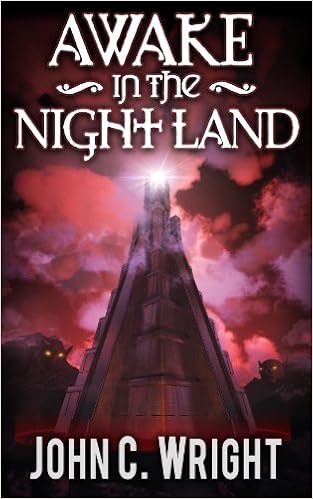
The Night Land -- John C. Wright, William Hodgson, et al

This is a collection of four novellas based on the world of William Hodgson's The Night Lands. The first novella is available as a free download, which I read before buying the full version. After reading the second one in the series, I went to Gutenberg.com and downloaded William H. Hodgson's book, The Night Lands. I'd say those actions should speak for themselves as to how much I liked John Wright's work.

William Hodgson's Night Lands could be up there with Middle Earth and the Star Wars universe, except that Hodgson's narration of it is so difficult to slough through. John Wright has done a commendable job of moving it into public literary consciousness with his excellent writing -- much easier to read while still using grand literary style.

The premise: it's millions of years in the future, the sun has died, and the earth is in darkness. The thick cloud surrounding the earth also blocks out the stars. A variety of horrific monsters have taken over the landscape, some of which can, not only kill the body, but also consume the soul as well. Humanity is surviving with the help of subterranean heat. Human technology of that time has enabled them to build a 7 mile tall pyramid shaped tower, called The Last Redoubt, capable of holding millions of people -- all that's left of humanity. Each floor is a whole city. For more details of the fascinating world, read the Wikipedia entry.

I never did finish William Hodgson's book. I got more than half way through, which was enough to give me the basic idea of the story. William Hodgson was a Victorian age writer, but he intentionally wrote it in 16th century style, from the narrative point of view of a gentleman living at the time. He falls in love with a young lady named Merdath. They marry, but she dies. During his mourning, he has a dream of the far future, where a reincarnation of himself, a young man, lives in the Last Reoubt. Through highly advanced instruments and his own telepathic powers (which humanity has developed by then), he hears a voice he recognises, that of the reincarnation of Merdath. She's calling from a lesser redoubt at the opposite end of the extremely deep valley in which both redoubts were built. They were built there because the air at the old earth's surface is too thin to breath. Also, in the valley, there are scattered pot holes of lava that are good for warming oneself. The Last Redoubt, itself, is warmed and energised by a large vein of subterranean energy.

After Hodgson's hero begins hearing the voice of his ancient lover, it becomes apparent that something horrible has happened to the Lesser Redoubt. The first half of the book is the journey through a landscape every bit as full and detailed as Tolkein's Middle Earth -- the difference being that almost everything is hostile and dangerous. He finds her, and the second half covers their journey home, and, I suppose, a bit of their life back at the Greater Redoubt. As I said, I didn't make it to the end, as a lot of that was more like a 16th century romance, with very wordy and detailed descriptions of their love, which didn't appeal to me.

When John C. Wright was young, Hodgson's book existed in two out-of-print volumes. Young John had found the first volume, read it up to the part where the hero was on the verge of finding Merdath, and spent the rest of his young adulthood pining for the second volume. Gutenburg.com wasn't around then. His compendium of novellas stays faithful to the world of William Hodgson, including the reincarnation aspect. Reincarnation is a necessary part of the Night Lands universe. John C. Wright is a Roman Catholic who doesn't believe in reincarnation, but neither does he, nor I, believe in witches riding on broomsticks or small men with hairy feet who live in holes, but we still enjoy an occasional story or two that feature such things.

The first three stories in Wright's collection are set in the Night Lands as Hodgson knew them. His story of the search and rescue of Merdath, is a part of the history. The fourth is set at the end of the universe as we know it, one that has passed the "Night Lands" phase of human history, but takes a twist that only John Wright can give it, with his brilliant adaptation of the physics of time and space.

My recommendation: discover the Night Lands through John C. Wright's book, and later, if your appetite has been sufficiently whetted, download William Hodgson's book.

Sunday, 2 August 2015

Limericks

The previous post was an extract from my book, Pappa Gander: the Less Better Half of Mother Goose, pictured to the right. That's basically a collection of my less serious attempts at rhyming, parody, and the retelling of well known fairy tales. There are other nursery rhyme parodies as well -- though mostly short ones -- but below, I'll paste a collection of limericks. Those of you who follow me on Facebook, may recognise some of them.


Barbarians and Samarians

Barb, a barbarian from Barbaria
And her man, lived in a wire barbed area
Sign said, 'Trespassers beware
Though I shoot first, I be fair.
If mistaken, I'll have my wife, Barb, bury ya.'

Samson and son, Sam, in Samaria
Lived in separate houses in the same area
Sign said, 'Trespassers beware.
But if you're feminine and fair,
I'll not shoot, but I'll have my son, Sam, marry ya.'

Reinventing the Wheel

when willie reinvented the wheel
we all laughed and called him a schlmiel
then it so happened
that he took out a patten
now it's his licence fees that make us reel

the first draft of a limerick:
a seemingly educated limericist named curdy
writes limericks too over exceedingly wordy
in spite of how much he tries
to sound educated and wise
one moreover wonders as to how one fringes so on the edges of absurdity

the final draft:
poet named curdy
was too wordy
being wise,
downsized
now sounds nerdy